
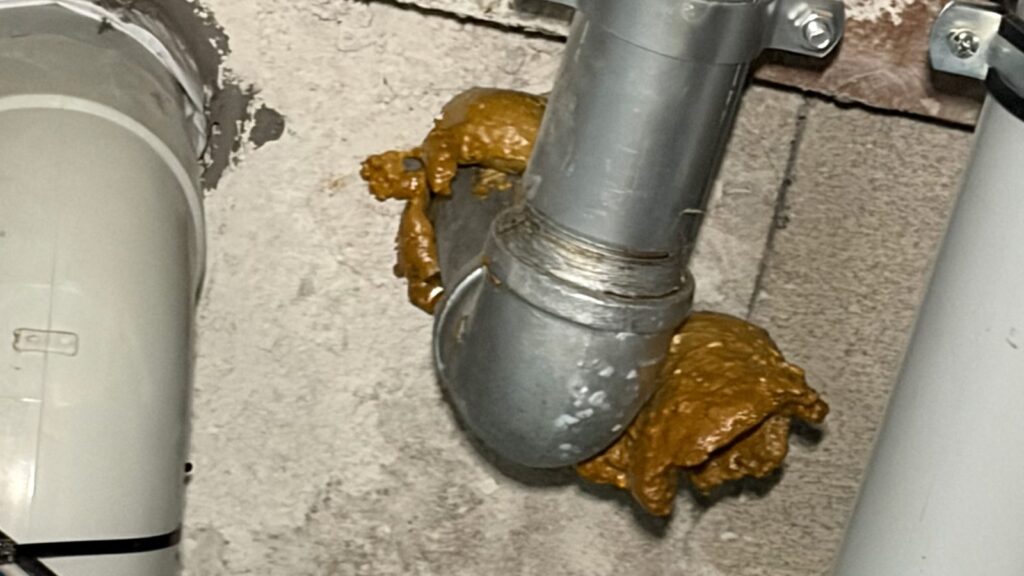
Short answer: no. The pink or orange “fire-rated” expanding foam sold in trade stores is a fire-retardant polyurethane foam. It is not a tested firestopping system for pipes, cables or ducts passing through a fire-rated wall or floor, and an IQP cannot accept it as one. If your building has foamed penetrations, they will keep appearing on the BWOF defect list until they are replaced with a tested system.
We get asked this a few times a year, usually by a building owner or a maintenance contractor who has just been told the foam has to come out. Often they send us the product’s technical data sheet and ask, quite reasonably, “It says tested to AS 1530.4. Are you saying it doesn’t meet the standard?” Here is the full answer.
What the can actually means by “fire rated”
Most fire-rated foams do carry a genuine AS 1530.4 test report. The catch is what was tested. Those reports cover a specific configuration, usually a linear gap of a stated width between two stated building elements, such as a plasterboard wall and a concrete soffit. Some cover small cable penetrations in a particular wall type. They do not cover a 100 mm PVC waste pipe through a concrete slab, a bundle of cables through a plasterboard riser wall, or an insulated copper pipe through anything.
A fire test result only applies to what was on the furnace. Change the service, the size, the substrate or the gap and the result no longer applies. That is why “tested to AS 1530.4” on a can does not make the foam a compliant seal around your pipe.
The standard that actually governs penetrations
In New Zealand, service penetrations through fire separations are covered by AS 4072.1, which is referenced by the Building Code’s Acceptable Solution C/AS2. AS 4072.1 requires a penetration seal to be a tested system: the specific product, installed in the specific way, around the specific service and substrate that was fire tested to AS 1530.4. That tested system comes with a fire resistance level, for example -/120/120, and an installation detail.
General-purpose fire-retardant foam has no such system behind it for service penetrations. The foam itself may slow ignition, but it does not maintain the fire resistance rating of the wall or floor once a plastic pipe softens or a cable sheath burns back. There is no detail, no FRL for your configuration, and therefore nothing for an IQP or Council to accept.
What a compliant seal looks like instead
| Service | Typical tested system |
|---|---|
| PVC or other plastic pipe | Intumescent fire collar or wrap, fixed to the tested detail on the correct side(s) of the element |
| Cables and cable trays | Fire-rated batt or board with intumescent sealant, or a tested sealant-only detail for small openings |
| Metal pipes (copper, steel) | Fire-rated sealant or batt system; insulated pipes need a detail that covers the insulation |
| Ductwork | Fire damper, or fire-rated duct wrap where the design allows |
| Gaps at the head of walls and junctions | Tested gap seal system (backing rod and fire-rated sealant, or mineral wool and sealant) |
Every one of these comes with a manufacturer’s tested detail. We install to that detail, photograph the item before and after, tag it, and record it so the IQP can sign it off.
“Is this a new requirement?”
No. Fire and smoke separations have always had to keep performing under the Building Code, and keeping them sealed is part of maintaining the building. An unsealed or foamed penetration found during an inspection is treated as a maintenance item, not a new rule being applied retrospectively. Older buildings are not exempt because the penetration was made years ago.
If your building has foamed penetrations
- Don’t pull it all out yourself. Removing foam without a replacement system in hand just leaves open holes.
- Get the list. Your IQP’s report or Council letter will say which penetrations failed and where. Send it to us with photos if you have them.
- We quote from the report, flagging any items that need a closer look on site, then remove the foam and install the tested system for each service and substrate.
- You get the documentation: before and after photos, tag numbers and a producer statement, which is what the IQP needs to clear the items.
Cost depends on how many items there are and where they are. Our passive fire remediation cost guide gives real ranges, from a minimum visit for one or two items up to multi-level jobs.
A note for trades
If you need to run a new cable or pipe through a wall that already has a proper firestop, don’t foam the new hole. For a single cable through an existing sealant or batt system, a tight-fitting hole re-sealed with a compatible intumescent sealant usually keeps the system compliant. For anything bigger, or if you are unsure what the existing system is, send us a photo before you cut. We can follow behind and provide the compliance documentation; a single penetration falls under our minimum call-out.
Frequently asked questions
The can says fire rated and tested to AS 1530.4. Isn’t that enough?
No. The test covers a specific gap or joint, not your pipe or cable through your wall. Service penetrations need a tested system under AS 4072.1 for that exact configuration.
Can you just seal over the foam with fire-rated sealant?
No. A tested system starts with the substrate and the service, not with a layer of foam. The foam comes out and the tested system goes in.
Does this apply to older buildings?
Yes. Fire separations have always had to be maintained. A foamed penetration is a maintenance defect regardless of when it was done.
What should be used instead?
Depends on the service: a fire collar or wrap for plastic pipe, batt and intumescent sealant for cables, a sealant or batt detail for metal pipes, dampers or wrap for ducts. Each has a tested detail we install to.
How much does it cost to fix?
From a minimum visit of about $950 plus materials and GST for one or two items, with typical single-building defect lists landing between $1,100 and $3,000. See the cost guide for the full ranges.