
Short answer: in 2026 the smallest passive fire remediation visit in Auckland costs about $950 plus materials and GST. A typical single-building BWOF defect list of 3 to 15 items runs $1,100 to $3,000. Remediation across several risers or a small fit-out runs $2,500 to $7,000, multi-level jobs $10,000 to $15,000, and major close-outs or new-build packages $20,000 and up. The rest of this guide explains where a job lands in those ranges and why.
These figures come from our own installed jobs across Auckland, Northland and North Waikato, every one tagged, photographed and recorded. They are ranges, not quotes. Your price depends on what the inspector actually found.
Why nobody publishes passive fire prices (and why we are)
Most passive fire contractors won’t put a number on a website because every penetration is different. That’s true. But if your IQP has just refused your Form 12A, or Council has sent a Notice to Fix, “it depends” is no use to you when you’re trying to budget or brief a body corporate committee. So here are the real ranges, with the reasons behind them.
The ranges
| Job size | What it usually is | Typical range (ex GST) |
|---|---|---|
| Minimum visit | One or two items: a fire collar, a cable penetration, smoke seals on one door | from about $950 + materials |
| Small defect list | 3 to 15 items from one IQP report in one building | $1,100 – $3,000 |
| Medium remediation | 15 to 40 items, several risers, or a small fit-out close-out | $2,500 – $7,000 |
| Larger remediation | 40 to 100 items across multiple levels, body corporate or commercial | $10,000 – $15,000 |
| Major remediation or new-build package | 100+ items, full fit-out close-out, or fire stopping priced from drawings | $20,000 – $30,000+ |
Why there’s a minimum charge
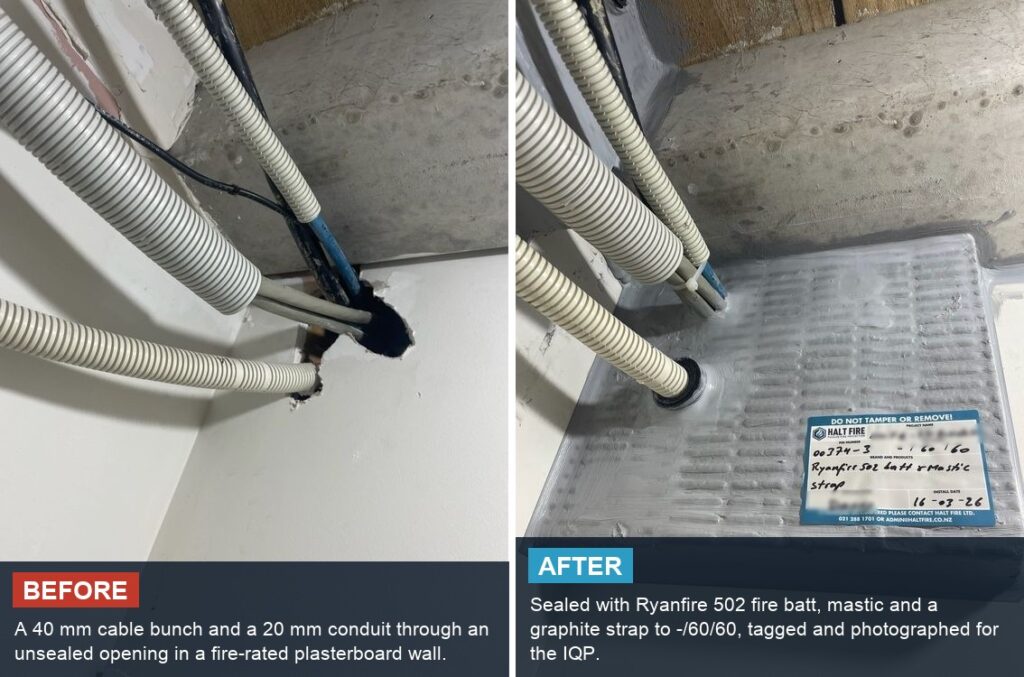
Every visit carries the same fixed work whether we seal one penetration or twenty: travel across Auckland, setup and access, the tested materials, before-and-after photographs of each item, the tag on the wall, and the completion report your IQP needs to sign the Form 12A. That is why a single fire collar is priced as a visit, not as a part.
What moves the price up or down
- How many items, and how close together. Fifteen penetrations in one riser cost far less per item than fifteen spread across four buildings.
- The service and the substrate. A PVC pipe through plasterboard is quick. An insulated copper pipe or a bundle of mixed services through a concrete slab takes a bigger system and more time.
- Access. Above a ceiling grid is fine. Above a plant room ceiling with no walkway, or anything needing a scissor lift, costs more.
- Fire rating required. A -/60/60 wall and a -/120/120 wall use different products and board build-ups.
- What the report actually says. Vague defect lists (“unsealed penetrations throughout”) need a survey first. Specific lists with photos can be priced straight away.
- Urgency. A Notice to Fix deadline next week is achievable, but it displaces booked work and is priced accordingly.
- Location. Within Auckland, travel is built into the price. Northland and Waikato jobs carry a travel line stated up front.
What’s included in our price
- Tested, appraised systems matched to each substrate, service and rating
- Before and after photo of every item
- A numbered Halt Fire tag on each seal
- As-built register and technical data sheets
- PS3 producer statement where the work is consented
- A completion report in the format IQPs and Auckland Council expect
What costs extra
- A site survey where the report is too vague to price from ($400 to $550, credited against the works if you proceed)
- Access equipment such as scissor lifts, charged at cost plus handling
- Travel outside Auckland, shown as its own line
- Items found on site that were not on the report, priced from the attached schedule of rates before we touch them
Three real examples
Figures are what these jobs would cost at our current 2026 pricing, rounded, ex GST.
- Two fire doors, Mt Albert apartment block. Smoke seals supplied and fitted to both doors in one visit, photographed and tagged. About $1,050.
- Industrial unit, Te Papapa, 21-item IQP list. Pipes, cables and openings through fire-rated walls across one building, one visit, register and photos for the Form 12A. About $2,300.
- Commercial building, Grafton, 50 penetrations. Service penetrations through fire-rated walls and floors for the main contractor during a refurbishment, tagged and documented with the PS3. About $11,400.
How to get a firm price
Send us the IQP report or the Council letter, plus photos if you have them. Most single-building lists are quoted within two to three working days. If the report is too vague to price, we’ll say so and offer a paid survey rather than guess.
Frequently asked questions
Can you give me a price over the phone?
For one or two clearly described items, yes, a range. For anything more we need the report or photos. Guessing low and varying later helps nobody.
Why is a fire collar $900 when the collar itself costs $60?
Because the collar is the cheapest part of the job. The visit, fixing it to the tested detail, the before and after photos, the tag and the report are what your IQP is signing off.
Is it cheaper to bundle several buildings?
Each building is a separate compliance item with its own report and sign-off, so each is priced on its own. We will book nearby jobs on the same day, which keeps travel down.
Do you charge for surveys?
Yes, and the fee is credited against the works if you go ahead. A proper survey is what stops variations later.
Do prices include GST?
No. All figures above are ex GST.
Will the price change once you’re on site?
Only for items that weren’t on the report, and only at the rates attached to your quote. You see the schedule before we start.
Damyn Blindell is the managing director of Halt Fire and a PS3 author who has worked in passive fire since 2008. Halt Fire installs and documents passive fire protection across Auckland, Northland and North Waikato.