
Passive fire deficiencies are one of the most common reasons a building fails its BWOF inspection. If your IQP has flagged issues, you have a legal obligation to get them fixed. Here is what that means and what to do next.
What Passive Fire Deficiencies Get Flagged
The most common issues we see in existing buildings are:
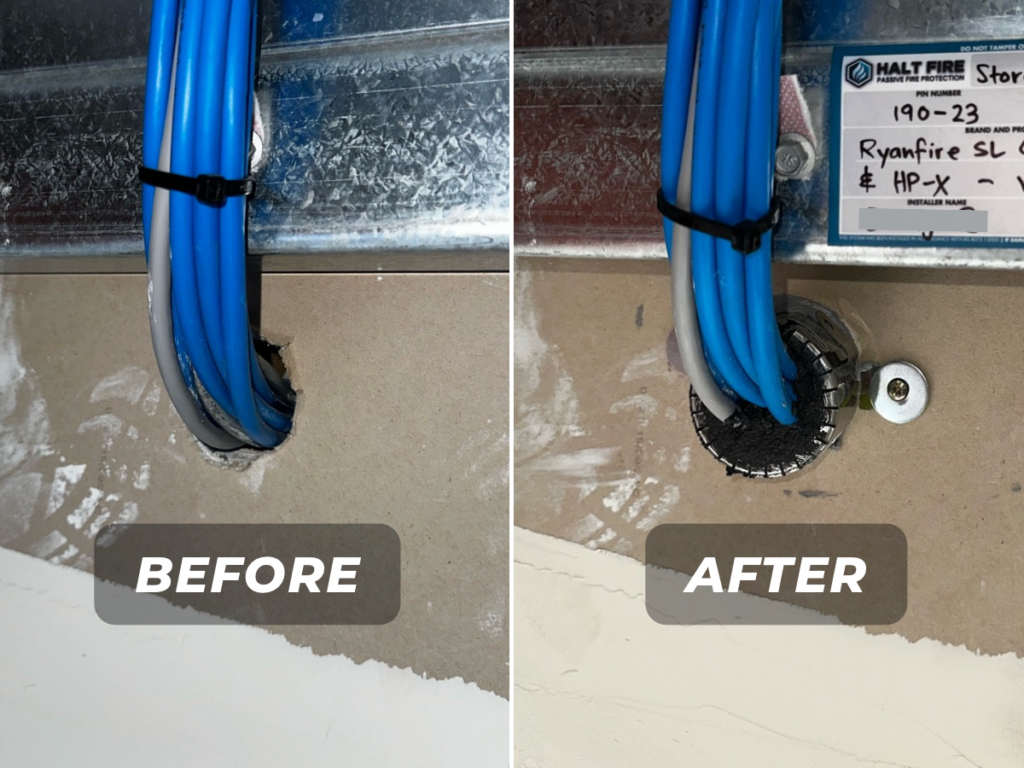
New service penetrations through fire-rated walls or floors with no fire stopping installed. A plumber, electrician, or HVAC trade has created a hole to run their services through and left it unsealed.
Removed services where the original fire stopping came out with the pipe or cable and was never reinstated. The penetration is now open.
Existing penetrations where the fire stopping was never compliant, or was correct at the time but no longer meets current standards. In many cases this has gone unnoticed through previous inspections. A more thorough inspector has now identified it.
Damaged fire doors or smoke doors on escape routes. Commonly failed through wear and tear or misuse, with damaged seals, faulty closers, or compromised door sets that no longer perform as required.
Who Is Responsible
The building owner is responsible for getting deficiencies remediated. The work must be carried out by a competent person who understands which fire stopping system is required for that specific penetration type, substrate, and fire resistance rating, and who can install it correctly. This is specialist work. Not every builder or general contractor has the knowledge to select and install the right system.
What Happens If You Ignore It
Your IQP cannot issue a Form 12A for any specified system where deficiencies remain unresolved. Without a Form 12A, you cannot issue your BWOF. From there, the council can issue a Notice to Fix with a deadline to remedy.
The penalties under the Building Act 2004 are significant. Building owners face fines of up to $20,000 plus $2,000 per day for ongoing non-compliance. In serious cases, permitting the use of an unsafe building carries fines of up to $100,000.
Beyond the fines, unresolved passive fire deficiencies leave your building genuinely at risk in the event of a fire.
How the Remediation Process Works
At Halt Fire, we keep this straightforward.
We start by reviewing any information you can provide. Whether that is a BWOF inspection report, an IQP deficiency notice, or council correspondence. We then carry out a site inspection to assess each deficiency and identify the correct fire stopping system for that specific scenario.
From there we provide a clear written quote detailing the systems we plan to use. Once accepted, we arrange a time that works for your building and its occupants and carry out the installation. Every penetration is photographed and recorded so you have a full as-built record of what was installed and where.
That documentation goes straight to your IQP or council inspector to close out the deficiency.
What You Receive on Completion
When Halt Fire completes passive fire remediation work you receive:
A photographic record of every installation.
A full as-built schedule recording the location of each penetration and the fire stopping system used.
Reference to the technical data sheet of the system installed, tying the work back to the tested and compliant system.
Confirmation from the qualified installer that the work was carried out in accordance with those requirements.
Damyn Blindell, Managing Director of Halt Fire, holds the NZQA New Zealand Certificate in Passive Fire Protection and is a certified PS3 author for passive fire protection with the Auckland Council.
Get It Sorted
If your building has passive fire deficiencies flagged through a BWOF inspection, contact Halt Fire. We will review your report, inspect the building, and provide a clear quote on what is required.