
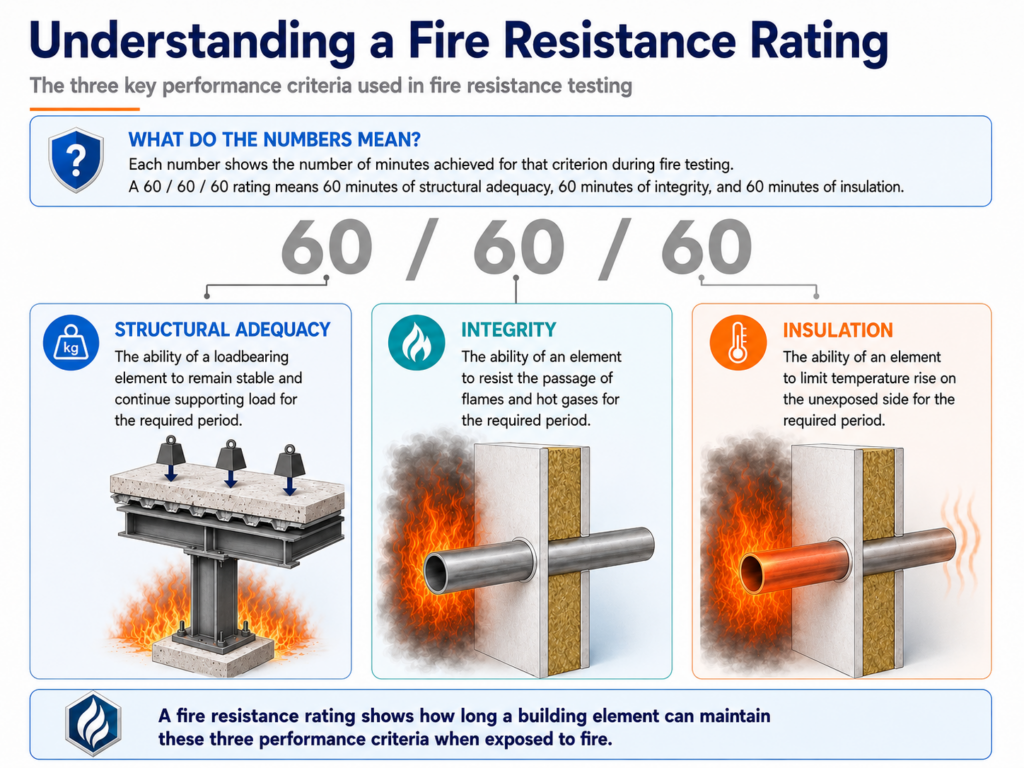
Ever seen a rating like 60/60/60 on a building element and wondered what it means? A Fire Resistance Rating (FRR) tells you how long a building element can keep doing its job in a fire, measured against three separate performance criteria.
What the numbers mean
Each number is a time in minutes achieved during fire testing. A 60/60/60 rating means 60 minutes of structural adequacy, 60 minutes of integrity, and 60 minutes of insulation.
The three performance criteria
- Structural adequacy. The ability of a loadbearing element to remain stable and keep supporting load for the required period.
- Integrity. The ability of an element to resist the passage of flames and hot gases for the required period.
- Insulation. The ability of an element to limit temperature rise on the unexposed (cool) side for the required period.
Why it matters for passive fire
A rating is only valid if the element is built and maintained exactly to the tested system. That is why passive fire systems like fire collars, penetration seals and fire-rated barriers must be installed to the tested method. Get the detail wrong and the rating does not hold, which is exactly what an IQP or BWOF inspection is checking.
Need help with passive fire compliance?
Failed a BWOF passive fire inspection, or not sure your fire separations are up to standard? Halt Fire provides passive fire remediation across Auckland, Northland and North Waikato. Get in touch for a free on-site quote, or call 021 288 1701.